
When the power shifts to the customer
AI is shifting power from platforms and consultancies back to the customer. But it takes domain knowledge, sound architecture and consultants who actually consult.
Category
14 articles in Architecture
AI is shifting power from platforms and consultancies back to the customer. But it takes domain knowledge, sound architecture and consultants who actually consult.
AI makes it possible to produce code faster than ever, but more code does not automatically mean more value. What AI really does is amplify the skill and judgement already present in the person or team using it. That makes the ability to understand the problem, spot risks and know what not to build more important than ever.
Technical debt is more than a technical concept, it is a business-critical reality that affects everything from time-to-market to customer experience. In e-commerce, where every millisecond and every click counts, the choices you make in your technical platform can have far-reaching consequences. When quick fixes are prioritised over long-term durability, an invisible but growing debt is built up. It affects not only development speed and stability, but at worst can slow the company's ability to innovate and compete. To face the future the right way, technical debt has to be understood, quantified and managed as the strategic investment it actually is.
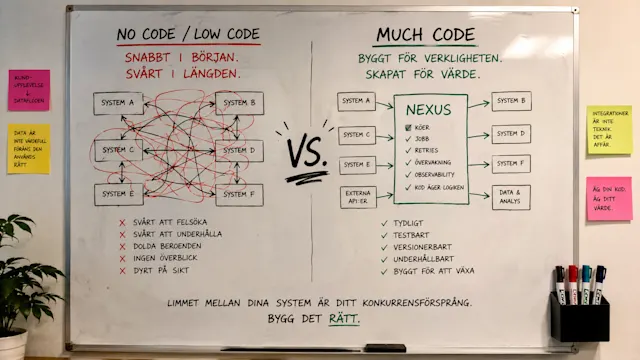
For many years 'no code' and 'low code' have been pitched as the answer to the integration problem. The promise has been simple: no developers, no code, just draw a few arrows between systems and everything is solved. Read on to see why 'much code' is a better option.
Price changes in e-commerce are often planned in advance and scheduled: either a change to the list price or a campaign price that takes effect on a specific date. Getting every system to show the new price at the right moment is a harder challenge than you might think, and in this article we walk through how to solve it with Nexus.
Syncing data between your e-commerce system and your search engine is something every e-commerce operator faces when they want an external search engine like Algolia, Voyado Elevate, Loop 54 or similar. In this article we walk through how to build that sync using Commerce Mind's tool Nexus.
Not everyone has really grasped that with headless and data layers comes the responsibility to think about how you handle your data. In short: leaking exact stock levels is more or less industry standard, but there are worse things that end up being published now and then.
Commerce Mind Nexus is a free framework we have built to help our clients improve their background processes and data flows, but above all to give visibility and control over them to non-technical people.
Interest in composable and headless architecture for e-commerce solutions has grown enormously in recent years. Composable offers many benefits but also comes with costs that are often not talked about. In this article I want to give a balanced view of the pros and cons of the different paths available when you shape your systems landscape.