For quite a few years it has been a natural aspiration for ambitious e-commerce operators to move towards a best-of-breed architecture, adding more and more SaaS services. But with a weaker economy, post-pandemic conditions and high interest rates, more players are starting to focus on operational efficiency and cost.
For quite a few years it has been a natural aspiration for ambitious e-commerce operators to move towards a best-of-breed architecture, taking in more and more SaaS services. Because we have been in a long stretch of good times, the attitude has been "you have to spend money to make money", and companies have perhaps not always done their long-term analysis of whether they really need the service, or whether it is a bit of a nice-to-have, or whether it really improves the efficiency of the business, drives revenue, lifts conversion and so on. That has also allowed SaaS services to charge quite a lot.
Now that we are probably heading into tougher times, it is natural to start reviewing costs, and if you have picked up many (smaller and larger) costs for services of questionable value, you have put yourself in a rather difficult spot. Can you cancel the service? What do you save by getting rid of a SaaS service? Are consulting fees required to actually be rid of it? Do we lose revenue as a result?
It is even harder, of course, with services you have bought in that are a central component of the e-commerce, like site search. Then it is not just a case of stopping using it, you also need to replace it with something more cost-efficient. The switch requires a one-off cost or investment, which can be hard to justify.
Right now these are tough times for companies with ill-considered implementations that do not deliver great value but come with expensive service and consulting bills. Combined with the fact that more companies are realising that the complexity of the headless world may not have been right for them, we at Commerce Mind see the pendulum swinging somewhat back to "simpler" solutions, where some companies are willing to compromise on the "perfect" best-of-breed architecture to get almost the whole way there with the out-of-the-box features of the larger, more monolithic platforms. For some e-commerce companies that previously invested heavily and were very willing to spend, an intervention-style process may be needed to cut back on costs. And that process hurts.
We think it is high time to sober up a little. Let us now adjust the costs for subscriptions, licences, implementation and maintenance to the actual benefit, revenue and margin we can reach. We think it will be important in the current environment for all niche SaaS services to not just try to lock customers into longer contracts, but to become clearer about how they actually help build e-commerce operators' profitability. Otherwise the axe will fall fairly soon.
But how do you even start? Start by ranking your expenses by cost and by how much uncertainty there is around the value they deliver to the business. Some items may have a high cost, but you know straight away that they give more value than they cost. Other items may cost less but you barely know what they are.
When you are done with the list, do not be afraid to reach out to other e-commerce operators for tips and advice. We are constantly surprised by how little non-competing e-commerce operators take advantage of the fact that others are sitting in exactly the same spot and happily share their experiences. You probably have something to contribute back too. Another option, of course, is to get in touch with us at Commerce Mind. We are happy to help you review your systems landscape.
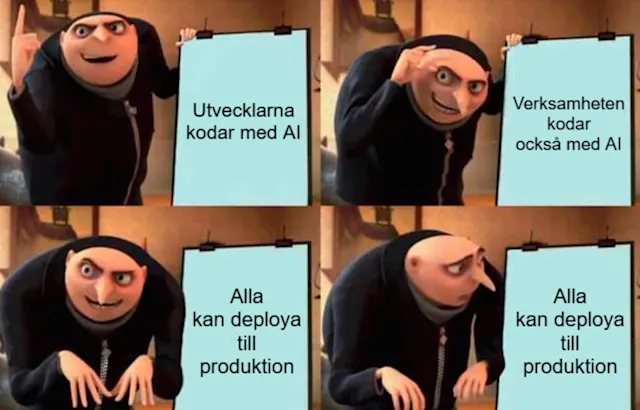
AI does not only make development faster, it moves the capability out into the whole organisation. Suddenly anyone can build and change things in the systems. It is enormously powerful, but combined with old ways of working it leads to either chaos or no effect at all. Here is how you lead the shift from tree-tender to forest ranger before entropy runs away from you.
Technical debt is more than a technical concept, it is a business-critical reality that affects everything from time-to-market to customer experience. In e-commerce, where every millisecond and every click counts, the choices you make in your technical platform can have far-reaching consequences. When quick fixes are prioritised over long-term durability, an invisible but growing debt is built up. It affects not only development speed and stability, but at worst can slow the company's ability to innovate and compete. To face the future the right way, technical debt has to be understood, quantified and managed as the strategic investment it actually is.
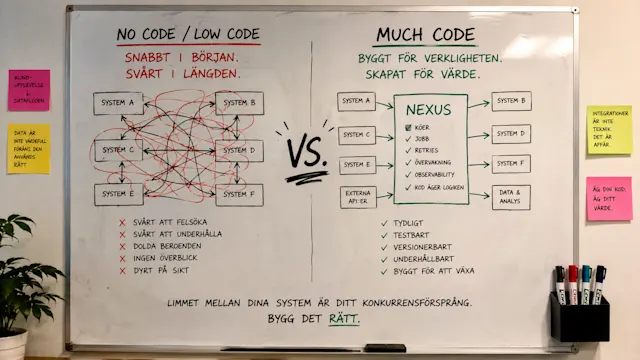
For many years 'no code' and 'low code' have been pitched as the answer to the integration problem. The promise has been simple: no developers, no code, just draw a few arrows between systems and everything is solved. Read on to see why 'much code' is a better option.