

When the power shifts to the customer
AI is shifting power from platforms and consultancies back to the customer. But it takes domain knowledge, sound architecture and consultants who actually consult.
When AI makes it possible for more people to produce more, expectations of what is normal to deliver rise as well. The competitive edge of the future therefore lies not just in using AI to move faster, but in the skill of using AI on the right things.
There is a lot of talk about how AI makes us more productive. And that is of course true. We can write faster, produce faster and go from idea to something useful in significantly less time than before.
But I think many people are staring themselves blind at the productivity increase.
What is often missed is that productivity does not exist in a vacuum. When it becomes easier for more people to reach a certain level, that level fairly quickly stops being impressive. It becomes the new normal. And when something becomes normal, expectations change too.
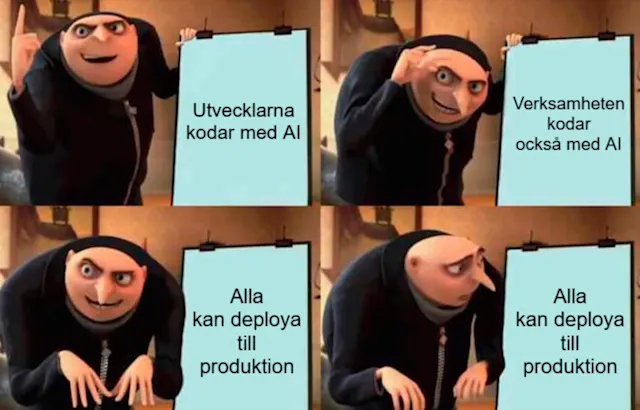
What yesterday required high competence can today be done by significantly more people with the help of AI. A person who previously could not have written code can build a simpler app. A person who previously could not have written a thorough document can get help structuring, formulating and improving it. A person who previously would have needed a whole team to develop a concept can get much further on their own.
And that is fantastic. But it does not mean competence becomes less important. It means the bar rises.
Imagine that yesterday it required fairly high technical competence to build a working prototype. It took time to understand the technology, write the code and put the whole together. Whoever could do it had a clear head start.
With AI, more people can now reach roughly the same result. They can describe what they want to build and ask AI to troubleshoot and step by step get to something that actually works.
Then it is easy to draw the conclusion that technical competence has become less important, but I think that is entirely the wrong conclusion.
What has happened is rather that yesterday's impressive results become tomorrow's baseline. What used to stand out becomes something more people can do. And when more people can do it, everyone will start expecting it. It is no longer enough to be able to produce the same result faster, because soon everyone is expected to do that.
We humans are bad at being impressed by efficiency gains long-term.
First we are surprised that something that used to take three weeks can now be done in three days. But after a while three days is no longer fast, it is just what we expect.
It is roughly the same mechanism as with all other technology development. When email became common, no one was impressed that you could send a message directly instead of posting a letter. When cloud services became standard, no one was impressed that you could spin up a server without ordering hardware. And so on.
And AI will go the same way, where what we today describe as an enormous productivity increase will soon be baked into normal expectations of what a person, a team or a vendor should be able to handle.
And this is where competence differences come back.
AI can help many more reach a higher baseline. That is perhaps one of the most powerful effects of the technology.
But it does not remove the difference between good and bad judgement. The person who already before understood the problem and the whole will not just be able to reach yesterday's level faster. That person will have a greater chance of reaching the new level that arises when everyone else has also become faster.
Because when everyone can produce more, it is no longer production itself that decides. It becomes direction, prioritisation and judgement.
What should we build?
Why should we build it?
What should we not build?
Which compromises are reasonable?
Which risks do we not yet see?
What happens when this solution has to live for five years, not five days?
AI can help with those questions, but it cannot take responsibility for them for us.
Many talk about AI as if the goal is to do the same thing as before, only faster and cheaper.
That is understandable and also a fairly natural first step. If a process used to take ten hours and now takes two, that is an obvious win.
But that is not where the change stops, because when the same work can be done faster, the organisation soon starts asking why you cannot also do more. Why you cannot test more ideas or create better decision documents or personalise more.
The old result, delivered faster, becomes just the first effect. The next effect is that the result needs to be better, and that is when it becomes clear that AI is not just a tool for productivity, it is also an expectations engine.
I think competence becomes more important in a world where AI makes more things easier. But not necessarily the same kind of competence as before. It will be less valuable to be able to do things manually that AI can do well enough. In the same way as previous big changes, like the need to understand how the computer's memory is built decreasing (but not disappearing) when programming languages more and more stopped handling memory manually. What we face now is the same principle, but of course on a much greater scale.
Instead it becomes more valuable to understand what is good enough, what is missing, what is the wrong direction and what actually creates value. And perhaps above all the trade-off in what can be done now and what can come later. Having a vision several steps ahead in a way today's AI cannot.
When the pace increases, the time for reflection shrinks unless you actively protect it. More things can be built, written, sent and decided. That means wrong decisions can have larger consequences faster. This is where experience, judgement and deep understanding still matter.
The person who yesterday had enough competence to meet yesterday's expectations often has better conditions with AI to meet tomorrow's expectations. Not because that person can write faster code, better copy or more analyses than everyone else. But because that person has a better chance of understanding which code, which copy and which analyses should actually be produced.
It is not just our expectations of what people can produce that grow, our expectations of what the systems we use can do will grow the same way. Many predict that the SaaS model is dead, because now anyone can build the same system themselves, so why pay a lot for a SaaS service?
The conclusion is not entirely wrong, but it assumes expectations stay still. That the bar is still at "what SaaS services could deliver yesterday". But what will instead happen is that more people will be able to offer what SaaS services could deliver yesterday, and the SaaS services that survive will be the ones that can raise their level as expectations grow.
Ones that can use their customer base, their organisation and their existing platform to take the next step up. Some SaaS companies will not manage it and will see themselves overtaken by newcomers. And some SaaS companies will be able to use their resources to lift themselves in ways a newcomer cannot.
The world of systems, platforms and services will be shaken up, and those best capable of using the new tools to their strength and breaking free from old patterns will stand as winners.
Some of the larger companies will find it hard to adjust their organisation to this. Previously, a large organisation was a prerequisite for being able to deliver. Now it is instead a risk if your organisation does not quickly learn to communicate and collaborate in a way suited to the new tools.
It is tempting to think AI evens out the playing field entirely, and to some extent it does. More people get access to tools that previously required specialists. More people can get further without first spending years building up the same technical or practical skills. We have as I said seen these changes before, but on a much smaller scale.
But execution itself is only part of the value. AI can democratise the possibility to produce, and it can help more people get started. It can give more people a language, a structure and a technical lever they previously lacked, but it does not automatically democratise judgement.
That is why the difference between people does not disappear. It just moves to another level.
AI will make us and already makes us more productive today. That question is almost uninteresting at this point.
The more interesting question is what happens when the increased productivity is no longer a competitive advantage, but a baseline expectation. When everyone is expected to be able to work faster, think more broadly and deliver more thorough results in less time, then it will not be enough to say you "use AI". Today you can call yourself an "AI company" and it sounds quite cool. But in a while it will sound about as cool as saying today "we are one of those companies that uses computers".
Instead the question will become how you use AI. Do you use AI to think better, test more perspectives, find weaknesses earlier and make better decisions?
That is where the next competitive advantage will lie.
Not in having access to AI. Everyone will have that.
But in having the skill to use AI on the right things.
Related articles
AI is shifting power from platforms and consultancies back to the customer. But it takes domain knowledge, sound architecture and consultants who actually consult.
If your e-commerce agency became three times as efficient, would your invoice shrink to a third? Probably not. AI is killing the billable hour as a business model, and suppliers are caught in a squeeze between shrinking hours and uncertain AI costs. Tobias Bergström walks through the pricing models you'll encounter, explains why a fixed price with AI built in is probably the best choice for you as a buyer, and lists the questions you should ask your agency.
AI does not only make development faster, it moves the capability out into the whole organisation. Suddenly anyone can build and change things in the systems. It is enormously powerful, but combined with old ways of working it leads to either chaos or no effect at all. Here is how you lead the shift from tree-tender to forest ranger before entropy runs away from you.