Is the SaaS-pocalypse here?
For a long time SaaS has been one of the most obvious paths within IT, but the model is beginning to strain as demands rise and the economics of software development shift. Which SaaS companies have what it takes to meet the new requirements?
By now quite a few people are speculating about the death of SaaS, or the SaaS-pocalypse. The lines of reasoning are flowing: "now that the cost of producing code is heading towards zero, everyone will build their own solutions and SaaS is doomed," but they miss half the point.
This is not a defence of SaaS, but you need to understand what the value of SaaS actually is before you write it off. You also need to understand that "the cost of producing code" is just a part of the whole. Code is not just produced and then everything is done. But that does not mean SaaS companies can carry on as before, unaffected by the massive changes we are seeing and above all will see in the software world.
For a long time SaaS has been one of the most obvious paths within IT. Instead of building, operating and continuously developing complex software yourself, companies have been able to pay a running cost to use systems someone else has already built. Why put time, money and risk into your own development when there are finished products that work, are updated continuously and are managed by experts in the field?
SaaS grew out of a clear frustration. Many companies were tired of their own systems, own operations, expensive implementations and slow development projects. Building yourself was often both complex and risky. It required developers, infrastructure, upgrades and long-term maintenance. SaaS offered an attractive alternative in using standardised platforms, packaged as services with a subscription cost and faster time-to-market. And, not least, significantly less responsibility for the technical whole.
That has worked very well, and in many cases it still works very well. But the premise that made SaaS such an obvious choice is starting to change.
With LLMs and AI, the economics of software development are shifting. It is no longer as expensive, slow or hard to write code. Writing code is of course not the only thing that has to be done, because the code has to be maintained, developed further and handled in various ways. But even there, AI can help lower the cost. It is still not free, but a much lower cost than before.
Code becomes cheaper to produce, ideas become easier to test, and adaptations that previously required large projects can be built faster. Sometimes even by people who never previously wrote a line of code.
That does not mean that everything about software suddenly becomes easy. Security, architecture, data, integrations and operations are still hard. But the cost of creating and changing software itself is falling dramatically. And when the cost of adaptation falls, expectations also rise.
When the SaaS model starts to chafe
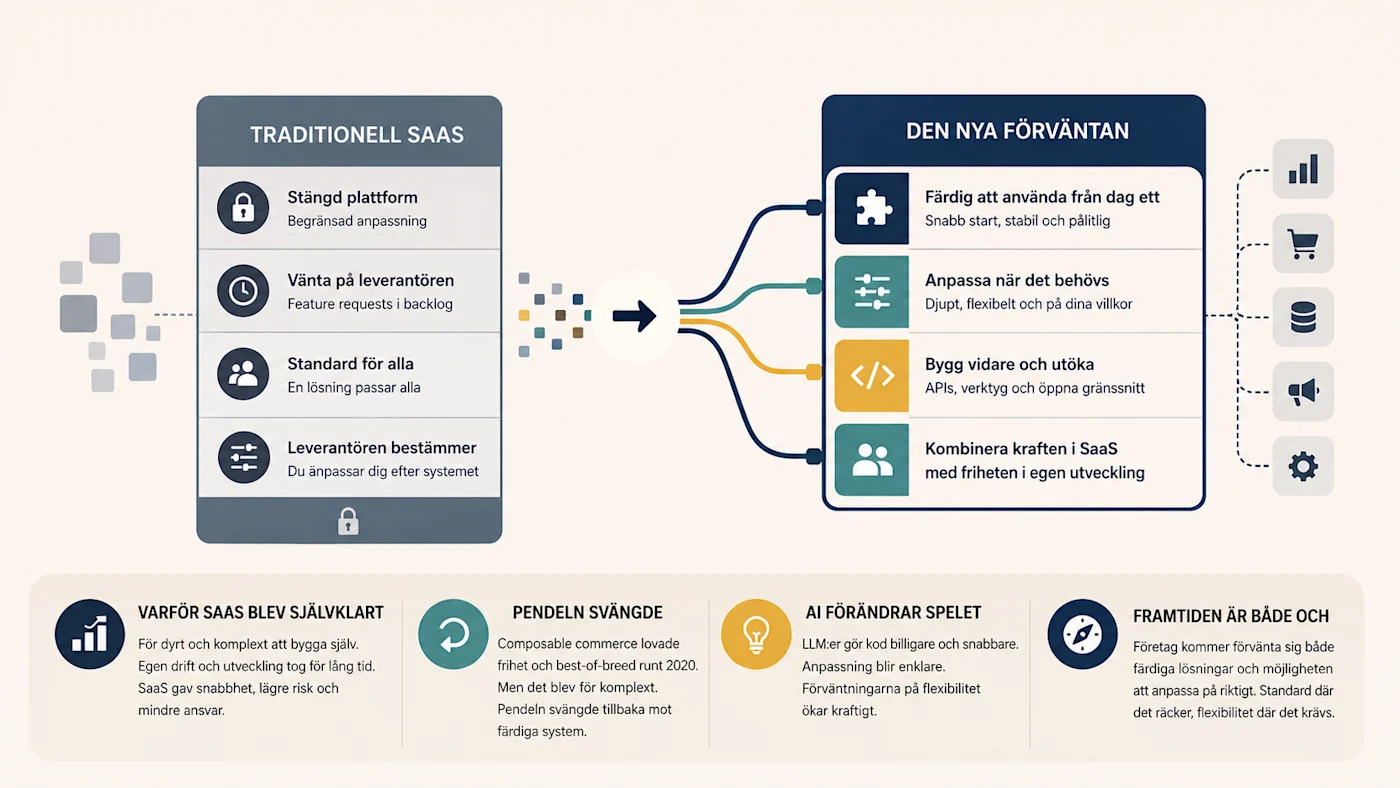
Traditionally, SaaS products have built on standardisation. All customers use fundamentally the same product. That is precisely what makes the model scalable. The vendor builds a feature, many customers benefit from it, and the product evolves over time. But for the customer it also brings constraints. If you want to do something that is not supported by the product, you either have to adapt to the system, find a workaround, or file a feature request and hope it gets prioritised.
For a long time that has been accepted. Companies have stood, cap in hand, asking their SaaS vendor to add a particular feature to the backlog. Sometimes the answer has been "yes", but often the answer has been "maybe". Quite often the answer has in practice been "no" but wrapped in a "we will think about it".
But in an AI-driven development world, that patience will diminish. When companies see that they themselves can create internal tools, integrations and flows in a fraction of the time compared to before, they will also start questioning why their business-critical SaaS systems are still so hard to adapt. Why should a system only be configurable within certain limits? Why should a unique process have to be squeezed into a standard model? Why can we not adapt the interfaces to fit our processes better?
This does not mean the end of SaaS. But it does mean that expectations of SaaS will change significantly.
The pendulum swings
We have seen similar pendulum swings before. Around 2020, composable commerce became one of the big buzzwords in e-commerce and e-commerce architecture. The thought was tempting: instead of buying one big, finished system, you would put together a best-of-breed solution yourself. An engine for product information, another for search, a third for checkout, a fourth for CMS, a fifth for personalisation, and so on.
On paper it sounded great. Why compromise with one large standard suite when you can pick the best component for each area? The problem was that reality turned out more complex than it seemed. Someone needed to own the whole, and someone needed to make all the systems talk to each other. Someone needed to explain to the business that to do X, they needed to log into system Y and not system Z, even though system Z also kind of handled X. That is why the pendulum swung back somewhat. Many people started asking again for finished systems. Platforms that work from day one. Less complexity and fewer integrations, with clearer responsibility and lower risk. People accepted less flexibility in exchange for faster implementation.
But the next pendulum swing will not look like the last one. The new ideal will not be either finished or flexible, it will be both.
Companies will expect systems that are finished and ready to use from day one, but that can at the same time be adapted deeply to their own business. They will want the stability, security and product development from SaaS, but the flexibility of self-developed software. They will want standard where standard is enough, and full customisability where the business requires it.
That places entirely new demands on the SaaS companies. It is not enough to offer a few settings in an admin interface, an API and a list of integrations. The SaaS products of the future will need to be more open, more programmable and more adaptable. They need to give customers the possibility to build on top of, alongside and sometimes inside the product without the whole SaaS model falling apart.
Pressure will come from two directions that SaaS companies previously did not have to think about. When it becomes easier to set up complex operating environments that can handle your traffic volumes, and when it becomes easier to build systems and interfaces yourself, the question "will it be cheaper if we do this ourselves?" will be asked much more often than before. It will not end with every e-commerce operator building their own e-commerce platform, PIM or ERP, but the question being asked will raise demands on the systems people use that did not exist before. They did not exist because it was simply too hard for everyone involved. But that is about to change.
So SaaS is not dead. But we will definitely see a new pressure on SaaS companies to prove their value in a new world.
Going forward, the winners will be the systems that manage to combine two things long seen as opposites: finished from day one, and truly adaptable.